
Do you remember that last-minute rush before your niece’s wedding in Mumbai? You ordered a perfect silk kurta online. But it arrived looking like a tent on your toddler.
Dressing children for festive events should be joyful, not stressful. Nothing ruins a family photo faster than a child tripping over long hems or pulling at a tight collar.
This guide makes finding the right size easy. You can learn how to choose the right size kids ethnic wear. Just focus on accurate body measurements and use brand-specific charts.
Buying traditional clothes needs more care than picking a basic t-shirt. Fabrics like brocade or heavy cotton don’t stretch. So, getting the right size is key for comfort.
Our tips help your little one feel confident at celebrations. The right size means no constant adjustments all evening.
Key Takeaways
- Measure chest and waist for precision.
- Check specific brand charts before buying.
- Allow extra room for movement in heavy fabrics.
- Account for growth spurts when selecting length.
- Verify return policies for seasonal outfits.
1. Why Getting the Right Size Matters in Kids Ethnic Wear
Choosing the right size for your child’s ethnic wear is very important. It makes them comfortable and keeps the clothes from wearing out too soon. Clothes that don’t fit right can be uncomfortable and need to be replaced often.
Comfort is Key: When kids wear clothes that fit well, they can play freely. They don’t have to worry about being uncomfortable. Ethnic wear, especially for special occasions, should be very comfortable.
Longevity of the Garment: The right size also makes clothes last longer. Clothes that are too tight might tear easily. Clothes that are too loose might wear out faster because they have too much fabric.
The right size makes clothes look better too. Clothes that fit well look nicer and make your child feel more confident and happy.
To get the perfect fit, you need to know your child’s measurements. You should also use a reliable kids ethnic wear size guide. This guide helps you understand different sizes and make good choices when buying clothes.
2. Understanding Kids Ethnic Wear Sizing Systems in India
Kids’ ethnic wear sizing in India is not the same everywhere. Parents need to know the different sizing charts and measurements. This is because brands and regions have their own ways of measuring.
2.1. Age-Based Sizing vs Measurement-Based Sizing
Kids’ clothing sizing can be split into two types. Age-based sizing uses the child’s age to pick the right size. Measurement-based sizing takes the child’s body measurements for a better fit.
“The key to dressing your child comfortably is understanding their measurements rather than relying solely on age.”
Measurement-based sizing is more accurate. It fits better because it considers how each child grows and their body shape.
2.2. How Indian Size Charts Differ from Western Standards
Indian size charts for kids’ ethnic wear are different from Western ones. This is because Indian and Western kids grow and look differently. For example, Indian kids might have different chest and waist sizes than Western kids of the same age.
| Size | Indian Size Chart (Chest Measurement) | Western Size Chart (Chest Measurement) |
|---|---|---|
| 4 Years | 22 inches | 24 inches |
| 6 Years | 24 inches | 26 inches |
| 8 Years | 26 inches | 28 inches |
2.3. Decoding Size Labels: S, M, L vs Numeric Sizing
Size labels on kids’ ethnic wear can be confusing. Some use letters (S, M, L), while others use numbers. Knowing these labels helps you choose the right size. Letter sizing can vary, but numeric sizing usually matches age or measurement.
2.4. Regional Variations in Kids Clothing Size Standards
Size standards can vary by region in India. This means different places have their own sizing preferences. For example, North India might have different sizes than South India.
To get the best fit, always check the size chart from the brand. Also, take your child’s measurements carefully.
3. Essential Body Measurements You Need to Take for Your Child
Getting the right size in kids’ ethnic wear starts with accurate body measurements. You need to take a few key measurements for a comfortable fit. This guide will help you pick the perfect size for your child.
3.1. Gathering the Right Measuring Tools
First, you need the right tools. You’ll need a flexible measuring tape, a ruler or scale for height, and a well-lit area. A digital measuring tape is great for easy use and precision.
3.2. Step-by-Step: How to Measure Chest and Bust Accurately
To measure your child’s chest or bust, wrap the tape around the fullest part. Keep the tape level and parallel to the floor. Make sure it’s not too tight or too loose. For younger children, you might need extra help.
- Stand your child straight with their arms down.
- Wrap the tape around their chest, under their arms.
- Take note of the measurement in inches or centimeters.
3.3. Step-by-Step: Measuring Waist Circumference Correctly
For waist circumference, wrap the tape around the narrowest part of their waist. For most children, this is just above the belly button.
- Have your child stand up straight.
- Identify the natural waistline.
- Wrap the tape around this area, ensuring it’s snug but not constricting.
- Record the measurement.
3.4. Step-by-Step: Taking Height and Garment Length Measurements
To measure height, stand your child against a wall without shoes. Use a ruler or a scale to mark their height on the wall, then measure from the floor to this mark. For garment length, measure from the shoulder, down to the desired length of the garment.
3.5. Step-by-Step: Measuring Shoulder Width and Sleeve Length
Measuring shoulder width involves determining the distance between the shoulder points. For sleeve length, measure from the shoulder point, down to the desired length.
- For shoulder width, have your child stand straight.
- Measure across their shoulders.
- For sleeve length, start at the shoulder edge and measure down to the wrist or desired length.
3.6. Recording and Organizing Your Child’s Measurements
Keep a record of your child’s measurements. Use a notebook or a digital note-taking app. Regularly update these measurements as your child grows.
4. How to Choose the Right Size Kids Ethnic Wear for Different Garment Types
Kids ethnic wear comes in many types. Knowing how to pick the right size is important. Each type has its own size needs based on design, fabric, and fit.
4.1. Sizing Guidelines for Kurtas and Kurta Pajama Sets
Kurtas and kurta pajama sets need to fit right for comfort and style. Take your child’s chest and length into account. The kurta should fit well, not too tight or too loose.
Here’s a size chart for kurtas:
| Age | Chest Measurement (inches) | Kurta Length (inches) |
|---|---|---|
| 2-3 Years | 22-24 | 20-22 |
| 4-5 Years | 24-26 | 22-24 |
| 6-8 Years | 26-28 | 24-26 |
4.2. Finding the Perfect Fit for Lehengas and Choli Sets
Lehengas and choli sets need careful sizing. Look at waist, hip, and height to get a good fit.
For lehengas, focus on waist and hip to avoid discomfort.
4.3. Size Selection for Sherwanis and Nehru Jackets
Sherwanis and Nehru jackets need exact measurements for a perfect fit. Check chest, shoulder, and length.
A good fit should allow for movement without being too loose.
4.4. Choosing Sizes for Anarkalis and Salwar Suits
Anarkalis and salwar suits are favorites for kids. Consider height, chest, and waist for the best fit.
Anarkalis need to match the child’s height for the right length.
4.5. Sizing Tips for Dhotis, Patialas, and Bottom Wear
For dhotis, patialas, and other bottom wear, waist and length are key. Make sure it’s not too tight or too loose.
Use the size chart from the maker and think about your child’s measurements for the best choice.
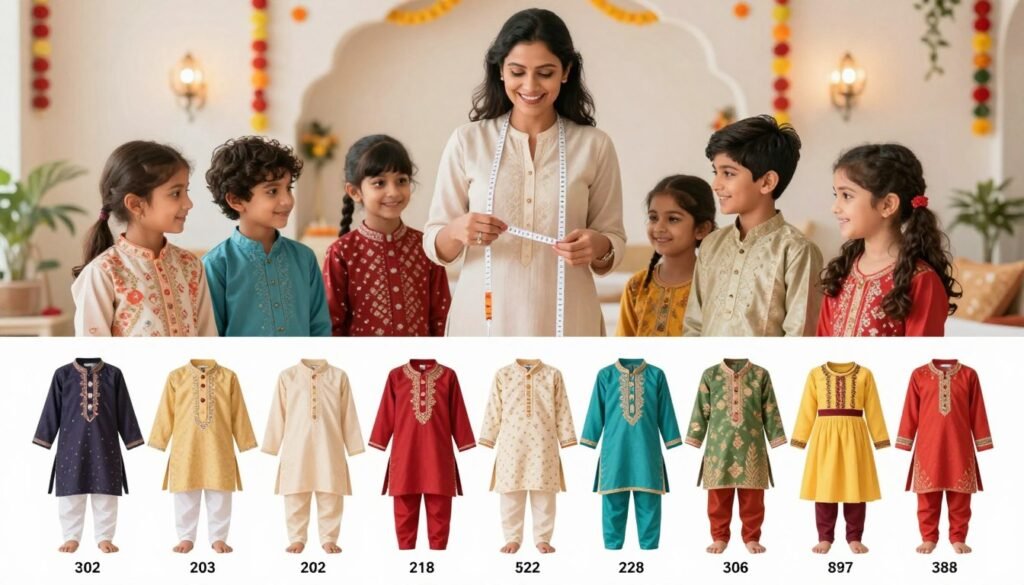
5. Age-Wise Kids Ethnic Wear Size Guide for Indian Children
Finding the right size for your child’s ethnic wear is key. It makes sure they are comfy and stylish. This is important for special days or just for fun.
5.1. Sizing for Infants and Toddlers: 0 to 3 Years
For little ones, size depends on age and weight. They look cute in tiny kurtas and lehenga cholis. Make sure to check their chest, waist, and height for a good fit.
Key Measurements: Chest, Waist, Height
5.2. What Size to Buy for Toddler Ethnic Wear: 3 to 6 Years
Toddlers love to move, so they need comfy clothes. Look for outfits with waistbands that adjust and soft fabrics. Sizes are usually 3T to 5T or XS to S.
| Age | Typical Size | Recommended Measurements |
|---|---|---|
| 3-4 Years | 3T or XS | Chest: 22-24 inches, Height: 36-40 inches |
| 5-6 Years | 5T or S | Chest: 24-26 inches, Height: 40-44 inches |
5.3. Size Selection for School-Age Children: 6 to 12 Years
As kids grow, sizes change a lot. It’s smart to measure them often for the best fit. Sizes usually go from S to XL.
5.4. Teenage Sizing Considerations: 12 Years and Above
Teens like different styles and sizes. Think about the fabric, design, and size when picking out clothes. Sizes can be from XS to XXL, so check the size chart.
Tip: Always check the size chart and read reviews for the best fit, especially online.
6. Smart Growth Allowance Strategies When Buying Kids Ethnic Wear
When you buy kids’ ethnic wear, think about how to fit their growth. Kids grow fast, and their clothes change quickly. A smart sizing plan helps you get the most from your buy.
6.1. How Much Extra Room to Allow Without Compromising Fit
It’s key to add extra room for growth. But too much can make clothes not fit right. For small items like kurtas, add 1-2 inches to their size.
For bigger items like lehengas, choose a size that grows with them. The fabric and design also matter. Stretchy fabrics can grow more than stiff ones.
6.2. Adjustable Design Features That Extend Garment Life
Some clothes have features that grow with your child. Look for waistbands, drawstrings, or velcro. These let you adjust the fit as they grow.
Anarkalis and salwar suits with adjustable waistbands are great. Kurtas with cuffs that adjust are also good for growing arms.
6.3. When to Size Up and When to Buy True to Current Size
Choosing between sizing up or buying the right size depends on several things. Consider how fast your child grows and the type of garment. For fast-growing kids, sizing up might be best. But for special occasions or stiff fabrics, true size is better.
6.4. Balancing Immediate Fit with Future Wearability
It’s important to find a balance between fit now and later. You want clothes that fit now and grow with your child. Think about the design, fabric, and how your child grows.
| Garment Type | Growth Allowance | Adjustable Features |
|---|---|---|
| Kurtas and Tops | Add 1-2 inches | Adjustable cuffs |
| Lehengas and Choli Sets | Consider a larger size | Adjustable waistbands |
| Sherwanis and Nehru Jackets | Size up for longer wear | Velcro or button adjustments |
By thinking about these points, you can make smart choices when buying kids’ ethnic wear. This ensures a good fit and long-lasting clothes.
7. Reading and Interpreting Brand-Specific Size Charts Correctly
It’s key to know how different brands size their clothes. This ensures your child gets the right fit for their ethnic wear. Each brand has its own way of measuring, so it’s important to learn about theirs.
7.1. Step-by-Step: Matching Your Measurements to Size Charts
To match your child’s measurements to a brand’s size chart, follow these steps:
- Take precise body measurements of your child.
- Refer to the brand’s size chart, usually found on their official website or product page.
- Compare your child’s measurements with the size chart to determine the best fit.
- Consider factors like fabric type and garment construction that might affect the fit.
7.2. Understanding Why Sizes Vary Between Ethnic Wear Brands
Sizes can change a lot between ethnic wear brands. This is because of different age groups, styles, and fabrics. Some brands have slimmer fits for younger kids, while others have looser fits for older ones.
Key factors influencing size variations include:
- Target age group and body type.
- Garment style and intended use.
- Fabric type and stretchability.
- Regional sizing standards.
7.3. What to Do When Your Child’s Measurements Fall Between Sizes
If your child’s measurements are between two sizes, here’s what to do:
- Opt for the larger size if you prefer a looser fit or if the garment is likely to shrink.
- Choose the smaller size for a more fitted look, ensuring it’s not too tight.
- Check if the brand offers customization or alteration services.
- Read customer reviews to understand how the garment fits in real-life scenarios.
7.4. Converting International Sizes to Indian Standards
Converting international sizes to Indian standards can be tricky. Here’s how to do it:
- Refer to the brand’s international size chart.
- Use online size conversion tools or charts that compare international sizes to Indian standards.
- Contact the seller or brand customer service for clarification on sizing.
- Consider ordering multiple sizes if possible, and return the ones that don’t fit.
8. Common Sizing Mistakes Parents Make and How to Avoid Them
Finding the perfect fit for your child’s ethnic wear can be tricky. Many parents make common sizing mistakes. Knowing these mistakes can save you time and money.
8.1. The Pitfall of Relying Solely on Age for Size Selection
Using only age to pick sizes can lead to clothes that don’t fit right. Kids grow at different rates and have different body types. Take your child’s measurements for a better fit. For example, knowing how to measure your child for a kurta is key.
8.2. Buying Excessively Large Sizes for Future Growth
It’s tempting to buy big sizes for growth. But, oversized clothes can be uncomfortable and look bad. Look for clothes with adjustable features or plan for size increases as your child grows.
8.3. Overlooking Fabric Stretch and Cut Variations
Different fabrics stretch differently, and the cut of a garment matters too. For example, a stretchy kurta fits differently than a non-stretch one. Always check the fabric and design when picking a size.
8.4. Ignoring the Specific Occasion and Wear Duration
The occasion and how long you’ll wear it should guide your sizing choice. For a special event, a looser fit might be okay. But for daily wear, a snug fit is better for all-day comfort.
8.8. Not Accounting for Body Type Differences
Children have different body types, and what fits one might not fit another. Think about your child’s body type when choosing sizes and styles. For instance, a slender child might need different sizing than an athletic one.
By avoiding these common sizing mistakes, you can make better choices. Your child’s ethnic wear will then fit well, be comfy, and look great.
9. How Fabric Types and Garment Construction Affect Sizing Choices
Knowing how fabrics and construction methods change sizing is key. It helps pick the perfect kids’ ethnic wear. The fabric and how it’s made can change how it fits and feels.
9.1. Stretchable Fabrics vs Non-Stretchable Materials
Choosing between stretchy and stiff fabrics matters for kids’ clothes. Stretchy fabrics, like cotton with elastane, are comfy and grow with your child. Stiff materials, like pure cotton or silk, need a closer fit.
Dr. Ritu Kumar, a famous fashion designer, said, “Comfort is as important as looks.”
“The right fabric can make all the difference in how a child feels in their clothes.”
9.2. Cotton, Silk, Georgette, and Synthetic Blend Considerations
Different fabrics have special qualities that change sizing. Cotton is cool but might shrink. Silk is fancy but can tear easily. Georgette flows well but might need size tweaks. Synthetic blends are tough but not as airy.
- Cotton: Breathable, may shrink
- Silk: Luxurious, delicate
- Georgette: Drape-friendly, may require adjustments
- Synthetic blends: Durable, less breathable
9.3. How Garment Construction Impacts Fit and Comfort
How a garment is made also matters for fit and feel. Things like seams, stitching, and details like pleats can change how it fits.
9.4. Adjusting Size Selection Based on Fabric Properties
To get the best fit, adjust your size choice based on fabric. For stretchy fabrics, choose a snug fit. For stiff ones, pick a bit looser or think about shrinkage.
Thinking about fabric and construction helps pick the right size for your child’s ethnic wear.
10. Proven Tips for Avoiding Size Exchange in Kids Clothes When Shopping Online
Shopping online for kids’ clothes can be easy. But, sizing issues can cause returns and exchanges. Knowing a few tips can help avoid these problems.
Using Customer Reviews to Gauge True Fit
Customer reviews are very helpful online. People share their experiences with sizing and comfort. Look for reviews that mention the sizing of the item you want.
See if the reviewer talks about their child’s height and weight. This helps you guess how the clothes will fit. Reviews also tell about fabric quality and if it shrinks.
Checking Detailed Product Dimensions and Specifications
Always check the product’s dimensions and specs before buying. Detailed measurements help you compare sizes. Look for size charts in inches or centimeters.
Some sites also list fabric type, length, and sleeve length. This info helps you choose the right size.
Understanding Return, Exchange, and Alteration Policies
Know the seller’s return, exchange, and alteration policies. Check if the seller offers free returns or exchanges and the time frame for them.
Some sellers offer alteration services. This can help if the clothes are not quite right. Knowing these policies makes online shopping safer.
Contacting Sellers for Clarification Before Purchase
If you’re unsure about sizing or fit, contact the seller. Many online retailers have customer service teams ready to help.
Ask about measurements, fabric, and stretch. Sellers can give insights not in the product description.
Taking Photos of Your Child for Virtual Fit Assessment
Some sites offer virtual fit assessments. You send photos, and they check the fit. This service is great for special occasion clothes.
Make sure your photos are clear and show the measurements the seller wants. This helps get a better fit.
11. Conclusion
Now you know how to pick the right size for kids’ ethnic wear. This makes buying clothes easier and more fun. It helps your child feel comfy and cool in their clothes.
Follow the tips in this article to avoid sizing mistakes. This way, you’ll find clothes that fit your child just right. Remember to think about the fabric, how the clothes are made, and how they’ll grow.
With these tips, you can dress your child in clothes that are both stylish and comfy. They’ll feel special and happy. Happy shopping!